Behind the famous Carstensz Pyramid are three climbing routes that are not only physically and technically challenging, but also convey meaning about the people, culture, and life that accompany each climber’s steps. Sugapa, Ilaga, and Tembagapura aka the three entrances to Indonesia’s highest peak, each of them have a unique story: about the people who live around the mountain, about a journey that tests trust between people, and about how climbers and locals are intertwined in one larger story. Choosing a route in Papua is not just about choosing a route; it is choosing a human experience that will last a lifetime.
Sugapa, Ilaga, or Tembagapura? Tracing the Path to Carstensz Pyramid Through Stories of Travel and Life in Papua
Sugapa: The Most Lively and Closest Route to Community Life
The Sugapa Trail is often considered the closest entry point to local life. From the start of the journey, hikers will encounter Dani people busy carrying agricultural produce, children scurrying in from afar, and families warming themselves around wood stoves.
The route passes traditional campsites, small gardens and simple wooden bridges.
Every step tells a small story: the aroma of smoke from a newly lit traditional house, the laughter of a child curious about the group of climbers, and the wary yet friendly gaze of an elderly person.
However, the Sugapa route also has quite tough challenges.
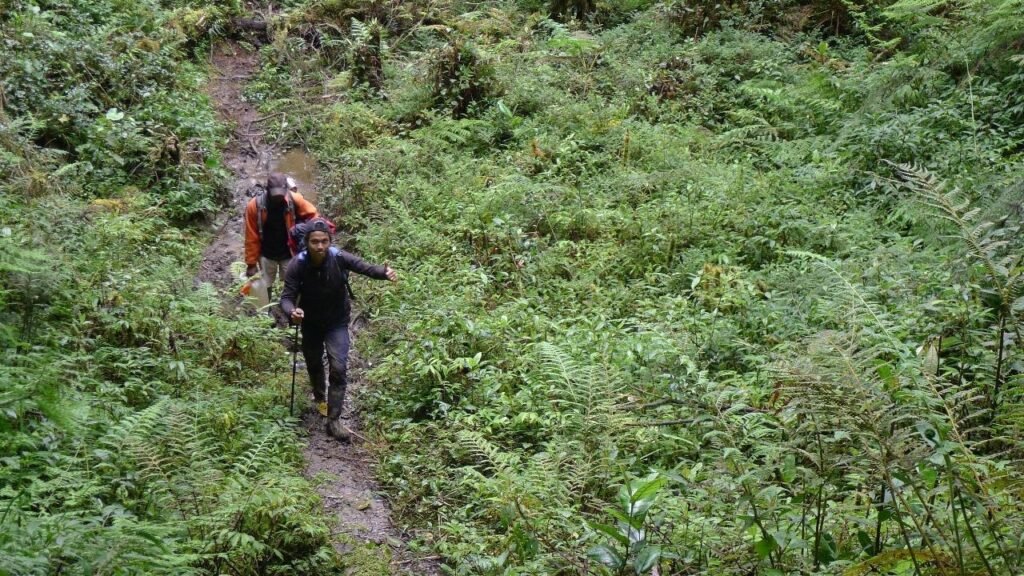
Heavy rains can arrive at any time, turning the dirt path into a thorny muddy mess. Climbers must navigate slippery slopes, large tree roots, and valleys traversed only by simple wooden crossings. All of this makes the Sugapa trail a test of physical endurance and adaptability.
Despite this, many climbers say that on the Sugapa trail they truly experience the true “soul of Papua”: a harsh yet warm lifestyle, and encounters with local people that make the journey feel more human.
Ilaga: A Silent Journey in the Heart of the Papuan Mountains
In contrast to Sugapa, which is bustling with village life, Ilaga offers a quiet companion on the journey. This less-traveled trail allows climbers to experience a calmer, more contemplative atmosphere. Here, the sounds of nature are more clearly audible, like the trickling of water, the rustling of the wind, and one’s own footsteps, which provide the rhythm of the climb.
The climbers passed through a mountain forest that was still very natural.
Large roots form natural steps, while thick moss covers the slippery rocks. The terrain in Ilaga is often unpredictable, with crumbling soil, steep slopes, and long valleys that require careful navigation.
However, behind this silence, there is a rich culture of local people who still maintain old traditions.
Many climbers feel that Ilaga provides a space for reflection, a time to understand how local people live in harmony with a harsh but meaningful nature.
In Ilaga, climbing isn’t just a journey to the top; it’s a journey within oneself, accompanied by the silence of Papua’s natural surroundings.
Tembagapura: A Route with More Stable Infrastructure, But Still Challenging
Tembagapura is a more organized and stable route than the other two. Because it’s located in a modernly managed area, access is clearer and the climbing process is more structured. Many guides choose this route for safety and logistical consistency.
But make no mistake! Despite its more controlled access, Tembagapura still presents challenges that are no less formidable.
Climbers will face slippery limestone terrain, vertical rocks that must be traversed with fixed ropes, and weather that can change drastically from rain to snow in a matter of minutes.
At some point, Tembagapura’s modern facilities end, and the wilderness takes over the trail once again.
Here, climbers realize that Carstensz is an unpredictable mountain. Every step toward the summit is accompanied by a sense of respect for the power of Papuan nature.
More Than Just a Trail: A Human Experience
Whichever route you’ll choose: Sugapa with its hospitality, Ilaga with its serenity, or Tembagapura with its clarity, climbers always return with more than just tales of the difficult trail. They return with the experience of meeting the resilient, friendly, and honest Papuan people.
They bring back memories of climbers who helped without saying a word, of the warmth of a campfire in the cold, or of moments when climbers and locals laughed even though they didn’t understand each other’s language.
Carstensz Pyramid is not only about the highest peak on the Australasian continent.
It is a meaningful journey, which teaches that every path has a soul, and every step is a meeting between human courage and natural beauty.
