MOUNT CARSTENSZ: BETWEEN THE MAJESTY OF NATURE AND THE CHALLENGES ON THE ROOF OF PAPUA
Mount Carstensz or Puncak Jaya is not just the highest mountain in Indonesia. It is a complex symbol of the encounter between the extreme realm, human challenges, and the changing times. Located in the heart of the Sudirman Mountains, Papua, Puncak Jaya rises up to 4,884 meters above sea level, becoming the highest point not only in Indonesia, but also in the entire Oceania continent according to Messner’s Seven Summits. The mountain’s uniqueness is not only due to its height, but also because of its position in a tropical region that geographically does not have evergreen snow — something that is now a major issue for the scientific world.
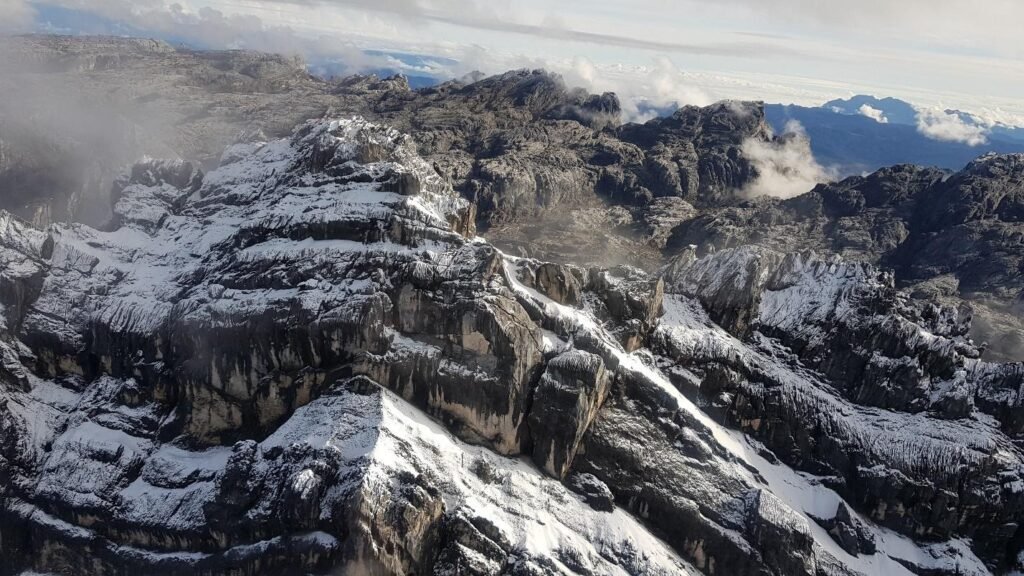
Geologically, Carstensz was formed from the complex movement of tectonic plates between the Indo-Australian Plate and the Pacific Plate. The multi-year process pushed the ancient seafloor up into giant limestone mountains. That’s why, unlike the volcanic mountains of western Indonesia, Carstensz has sharp limestone cliffs and challenging vertical walls. The landscape is arid and rocky, almost devoid of trees, yet it presents an incredible panorama of a world that feels detached from Indonesia’s tropical reality.
However, behind its geological beauty, Carstensz presents extreme challenges for climbers. The path to basecamp alone is already a long journey through valleys, swamps, and dense rainforests. Many expeditions start from the Sugapa or Ilaga areas, where climbers have to negotiate with erratic weather and hard-to-access terrain. Upon arrival at the foot of the mountain, the climbing terrain changes drastically: steep limestone, narrow crevices, and vertical walls that require advanced rock climbing techniques. Climbers use ropes, harnesses, carabiners, and via ferrata devices to conquer the truly technical trails. For many of the world’s climbers, Carstensz is more like a professional rock climbing expedition than a regular mountain climber.
In addition to technical challenges, the weather in Carstensz is also a major enemy. Temperatures above 4,000 meters can drop to below zero degrees, while rain, thick fog and blizzards can come suddenly. In this region, the boundary between rain and snow is often blurred. Many climbers have to wait days at the camp due to bad weather that makes the rock walls slippery and dangerous. It is these extreme conditions that have made Carstensz called “the most technically difficult of the Seven Summits” — the most technically challenging of the world’s seven highest peaks.
But now, Carstensz is also a silent witness to global climate change. In the past, its summit was covered by thick glaciers known as Carstensz Glacier, Northwall Firn, and East Northwall Firn. But in recent decades, that snow has all but disappeared. Researchers from various universities, including LIPI and international research bodies, noted that the glaciers in Puncak Jaya have shrunk by more than 80% since the 1980s. In the next twenty years, it is estimated that the perennial snow in Papua could completely disappear. The loss of the Carstensz glacier is not only a loss of natural aesthetics, but also a marker that climate change has reached a point that has even touched the highest peaks of the country.
On the other hand, the social life around the Carstensz area has its own dynamics. This area is part of the customary territory of indigenous Papuan tribes such as Amungme and Dani. For them, mountains are a sacred place, a symbol of the relationship between humans, nature, and ancestors. Puncak Jaya is not just a rock and snow, but part of a spiritual identity that is respected by certain customary rules. Climbs that are undertaken without regard for local cultural values often create tension, so it is important for modern expeditions to establish communication and respect for the communities that have lived there for thousands of years.
In addition to the cultural aspect, the existence of the Grasberg mine, one of the largest gold and copper mines in the world operating in the Sudirman Mountains area, also affects the environment around Carstensz. Large-scale industrial activity in the region often raises debates between economic value and nature conservation. For some, Carstensz is not just the top of the mountain, but a symbol of the clash between pure nature, resource exploitation, and the struggle of indigenous peoples to protect their land.
With all that complexity, Mount Carstensz is not just a climbing destination, but also a space for reflection on man’s relationship with nature. He taught that splendor is not always within reach, that every step towards the top brings a reflection on struggle, courage and respect for the environment. When the ice completely melts one day, perhaps Carstensz will lose some of his physical form, but the values and stories attached to him will remain part of Indonesia’s identity — a silent witness to how extraordinary this land is, from the deepest ocean to its highest peak.
