“PMA practices the concept of Sustainable and Regenerative Tourism”
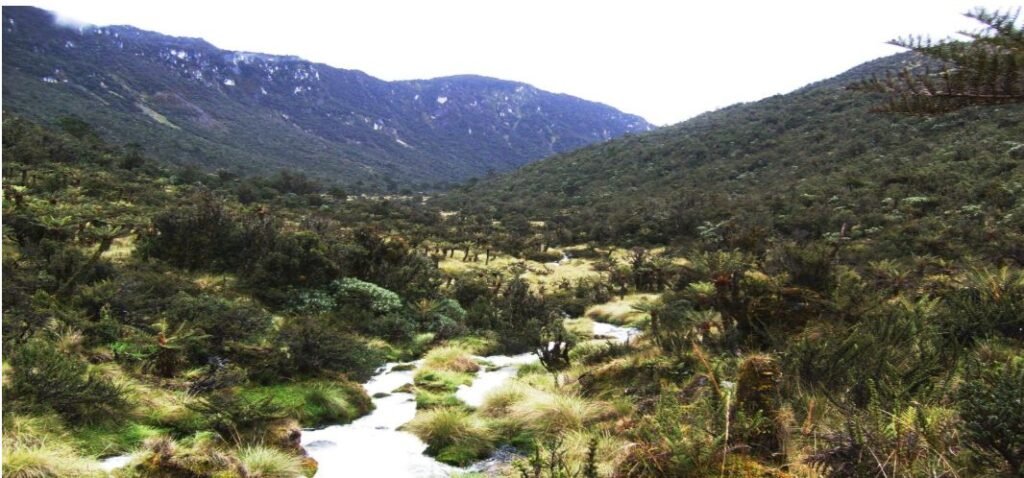
Central Papua, Timika — Spectacular natural views, as if “the Garden of Eden also exists in the land of Cenderawasih,
”in the alpine zone transition area on the Carstenzs Pyramid hiking trail
Extreme rock climbers, both national and international, have climbed Carstenzs Pyramid Peak numerous times. They are often facilitated by the Papua Mountaineering Association (PMA) and the Carstenzs Adventures Travel Agency.
Up there, climbers’ primary focus is their adventure to reach the summit of Carstenzs Pyramid, 4,884 meters above sea level, via the best available traditional routes. For example, via Ugimba Village, Intan Jaya Regency, to Carstenzs Pyramid, located in Mimika Regency, Central Papua Province.
Furthermore, mountain adventurers will also be treated to a breathtaking experience, a stunning view of the surrounding natural landscape, a verdant valley, with its green-gray mountains, white clouds, and blue skies. It seems to resemble a piece of the Garden of Eden, as depicted in films and songs praising Papuan nature. “Yes… if I may imagine it, it’s like a ‘little paradise’ that has fallen to earth,’ unmatched by any other natural vegetation on Earth. This view is truly unique to Papua. It gives the impression of a small portion of the vast courtyard of the Garden of Eden, the land of Cenderawasih, which stretches across this equatorial region.” And the main photo above illustrates this fact. That’s one beautiful natural setting along the trekking trail to the summit of the Carstensz Pyramid, 4,884 meters above sea level.
Certain species of vascular plants, uniquely adapted to the local mountain climate, thrive there, with its low temperatures, humidity, cold, and snow. These range from densely growing trees with slender, tapering trunks. There are also tree ferns, ferns, grasses, and plants that evolved from mosses, such as orchids, lichens, and mountain mosses.
These types of plants are typically found in mountainous areas with elevations ranging from 1,500 to 2,400 meters to 3,200 meters above sea level (masl). According to the concept of landscape zoning proposed by experts, these plants are found in three elevation zones: Montana (2,000 to 2,200 masl), Sub-Alpine (2,400 masl), and Alpine (3,200 masl).
Tourism with a Local Natural Knowledge Education Concept
With this natural environmental knowledge available, the Carstensz Pyramid summit tour offers more than just the thrill of reaching the 4,884-meter-above-sea-level summit. It also incorporates educational content, allowing visitors to observe the surrounding environment. This ensures that after their adventure, mountaineers return home with a lasting impression they can share with others. This aligns with the tourism vision model of the Papua Mountaineering Association (PMA) and its travel agent,Adventures Carstenzs (AC), said Maximus Tipagau, Head of PMA and AC.
Aligned with Government Programs, Sustainable and Regenerative Tourism
Also, according to Maximus Tipagau, “the tourism activity models implemented by PMA and AC are aligned with the program of the Ministry of Tourism of the Republic of Indonesia, which has been promoted for several years in the tourism sector. The government requires that national tourism activities be conducted with reference to the concepts of Sustainable Tourism and Regenerative Tourism,” he said.
The following is a summary of the two government recommendations:
First, “Sustainable Tourism” refers to tourism development that not only provides economic benefits but also considers the social and environmental impacts it generates. Sustainable tourism has several important aspects. One of them relates to the objective of this article: “Environmental Protection.” This means encouraging responsible management of natural resources, preserving and maintaining a clean environment, and reducing the negative impacts of tourism activities on ecosystems.
Second, “Regenerative Tourism” is a tourism approach that focuses on the restoration and regeneration of the environment and local communities. With the goal of improving tourist destinations beyond their original state, regenerative tourism goes beyond conservation, inspiring visitors to have a positive environmental and social impact on a destination. This includes engaging tourists in concrete activities to improve the environment, such as waste management, preserving endemic flora and fauna, and so on. This provides long-term benefits for both the destination and the local community. This means that regenerative tourism encourages the involvement of visitors and local communities in the planning, protection, and management of tourism. This allows them to experience the positive environmental, economic, and social value of their tourism activities.
PMA has implemented the government’s recommendations!
In this regard, the Papua Mountaineering Association has been paying close attention to the environmental and social impacts of tourism activities. “In its activities, PMA has implemented two government recommendations, namely Sustainable Tourism and Regenerative Tourism, as a form of moral responsibility for environmental preservation in existing tourist areas,” explained Maximus Tipagau.
For example, since 2018, PMA has conducted several clean-ups of trash left behind by tourists climbing Carstenzs Pyramid Peak.
The PMA Team cleaned up non-organic waste, including plastic and other environmentally unfriendly items, left behind over several years by tourists climbing Carstenzs Pyramid. The clean-up on the Carstenzs Pyramid hiking trail was initially initiated by a Canadian tourist and carried out jointly by Maximus Tipagau, the PMA leader, and his team of guides.
According to Maximus, PMA’s environmental actions serve as a moral message and awareness-raising campaign for prospective climbers and any stakeholders interested in the Carstenzs Pyramid area. The climbing tourism “In its future development, Carstenz Pyramid must be oriented towards saving, securing, and protecting the surrounding environment. This means it must be free of non-organic waste, be sustainable, and encourage tourists to find a harmonious relationship with the natural environment and its community,” he said.
And for facts about the trash cleanup on the Carstenz Pyramid hiking trail, you can click the following link to read more:
Grasslands and Fern Forests on the Carstenz Pyramid hiking trail
Furthermore, at the end of this article, as bonus information, we present a special description and story about the grass plants and ancient fern trees that grow as decorations in the natural park along the Carstenz Pyramid hiking trail.
This is part of the biodiversity of Lorentz National Park in Papua, which covers an area of 2,238,683.31 hectares. It spans three provinces (Central Papua, Papua Pegungan, South Papua) and 11 regencies: Mimika, Paniai, Intan Jaya, Puncak, Puncak Jaya, Lani Jaya, Jayawijaya, Yahukimo, Yalimo, Nduga, and Asmat.
The expanse of grasslands in this wet, humid, and cool mountain ecoregion appears lush and sustainable, adding to the surrounding natural beauty. This type of mountain grass creates a strong impression, growing naturally in the landscape and rooted in the germplasm soil layer of the Papuan highlands nature conservation environment. Collaborating with a group of Papuan mountain fern tree varieties, or ancient ferns (Cyathea atrox), and others that also thrive in their habitat, this beautiful, grassy, flat valley area will undoubtedly leave an unforgettable impression on climbers of Carstenzs Pyramid.
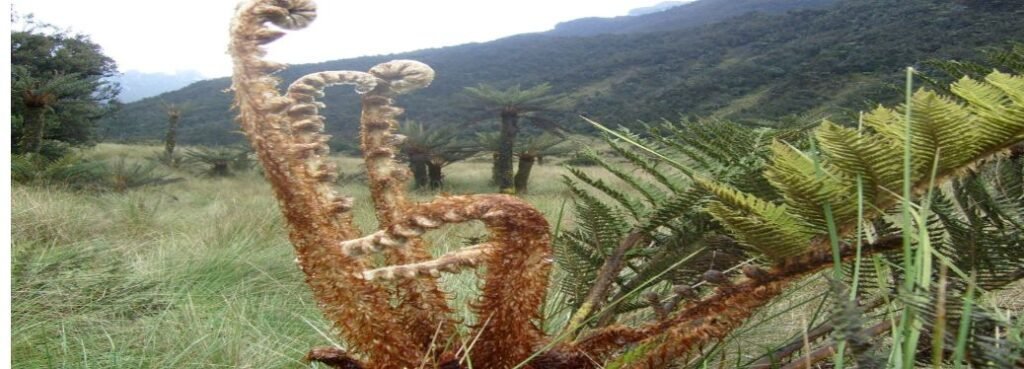
New shoots of an ancient tree fern (Cyathea atrox) growing in the sub-alpine transition zone on the Cartensz Pyramid
And as depicted in another image below, it can be categorized as a “Fern forest in the grassland.” This is another unique natural landscape that complements the climb to the 4,884-meter-above-sea level Carstenzs Pyramid.
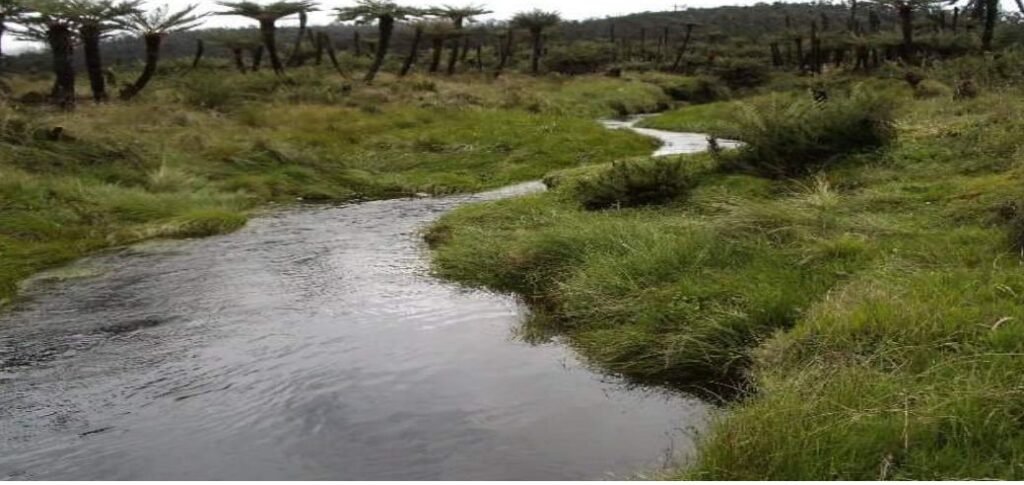
Sub-alpine meadows and clusters of ancient fern trees on a hiking trail fed
by a river originating from the Carstenzs Pyramid glacier
According to Wikipedia, “The plant communities in the Papua ecoregion include grasslands that grow and thrive in the sub-alpine zone at around 3,000 meters above sea level, consisting of shrubland and transitioning to alpine grassland. The Central Mountains Sub-alpine Grasslands is an ecological region of montane grassland and shrubland on the island of New Guinea. This ecological region encompasses the highlands of New Guinea (western Papua in Indonesia and eastern Papua in PNG) at the highest elevations, stretching along the island’s east-west ridge.”
Rare sub-alpine and tropical alpine habitats are also found here, including diverse flora and endemic animals that are protected. It also serves as a natural environmental resource that can enhance the tourism potential of the Carstensz Pyramid route. (Gasper Muabuay, Article Contributor for PMA+CA)
